
Dr Damian Smith is the author of the collection monograph ‘The Geoff Raby Collection of Contemporary Chinese Art’. He is the Director of ACAE Gallery, Melbourne, and President of the Australian Chinese Art Research Institute.
Akin to seeing European tall ships depicted in aboriginal cave paintings in Australia, Uyghur artist Aniwar Mamat’s artworks embody a distinct meeting of tradition and modernity where radically contrasting world views collide and intermingle. In instances such as these, the ‘shock of the new’ is no more apparent, no more palpable and no more prescient as to the realities of cultural loss, cultural change and cultural growth that are inevitabilities when two or more cultures come into contact. For the first time in Australia, a solo exhibition of Aniwar Mamat’s artworks, curated by Dr Geoff Raby, is being held at Vermillion Gallery. Located in Walsh Bay, the gallery is notably near to where in 1788 Captain Arthur Phillip first arrived with his convict ships on the lands of the Eora people. That landing set in chain continuous waves of confrontation, resistance and change that ultimately shaped the texture and tenor of modern-dayAustralia. In contrast, Aniwar Mamat’s works emerge at a time of unprecedented change in Xinjiang and reflect the complex realities of life in that remote corner of China.
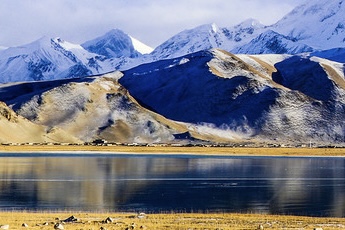
The View of Kashgar
ANIWAR MAMAT: BORDERLANDS
For centuries the oasis town of Kashgar has lain at the western edge of the Tarim Basin serving as a hub for the famed Silk Road trading route. Located at the foot of the Pamirs, at a crossroads between the Tian Shan and Kunlun ranges, Kashgar is one of the longest inhabited cities anywhere in the world. Against the arid climate it has sheltered locals and visitors alike, all the while enticing travellers fascinated by this remotest of hard-to-access places.
About 250 kilometres south of Kashgar is Kargilik (Yecheng 叶城),the birthplace of Uyghur artist Aniwar Mamat (b.1962-). One of the region’s preeminent contemporary artists, Mamat spent his early years between Kargilik and his mother’s hometown of Kashgar. Trained in Tianjin before graduating from the Minzu (ethnic minority) University of China, Aniwar’s paintings and wool-felt artworks are entirely distinct from the traditional art of the region. Notably, Kashgar boasts its own form of Islamic geometric patterning. The comparatively restrained exterior tiling of the Afaq Khoja Mausoleum, where bands of coloured tiles form a loosely gridded arrangement, is a case in point. One can also look to the decorative wool-felt (Kigiz) carpets with their bright patterns and orderly designs, which, nowadays are only made in Mamat’s hometown of Kargilik. In contrast to these, Mamat’s preference is for asymmetrically placed rectangles and stripes lain down in vivid and contrasting hues. Order and chaos are evoked in these aesthetically uncompromising assemblages, the likes of which provoke questions and reflections about their meaning, origins and intent.
In certain artworks the jockeying of squared-off forms seems oddly reminiscent of Kashgar’s vernacular mud brick and poplar houses, which when seen from the air reveal the jostling in-fill of urban space. Such buildings in the old town spread out in abstract geometric patterns defined as much by the local terrain as by the dictates of an organically expanding community. Both the houses and Mamat’s motifs are marked by a hand-made approach to their rectangular forms, standing distinct against the current onslaught of hyper-modernity across all aspects of life.

More intriguingly is Mamat’s interest in the early art of Soviet Russia, namely the Russian Suprematists whose bold assault on pictorial representation left a defining mark in the history of Modern art globally. In a WeChat exchange with Geoff Raby, Mamat outlined his youthful encounters in 1980 with the Suprematist aesthetic, discovered in forbidden books buried, due to Mao-era restrictions, in the state-run library in Urumqi where his mother found employment. Works by artists Kazimir Malevich and Wassily Kandinsky were especially inspiring. Curiously, as Mamat subsequently discovered in 1984, his experiences in the library offered him an advantage over the students at the Beijing Academy of Art who had had no exposure to Western art at that time. Here in miniature is one of those fortuitous caravanserai occurrences, wherein ideas and forms from the remote far West found their way across impossible distances and mountains to lodge in the mind of an aspiring artist. Such impressions, combined with a wider array of inputs, were stored away and later blossomed into the works currently on show. In place of arabesques and curlicues, one sees the hard line of modernity imposed onto softer surfaces and backgrounds. Kazimir Malevich’s infamous ‘black square’ had found its way to Xinjiang.
In the logic of the Constructivists and later the artists of the Bauhaus, the imposition of the grid as a fundamental principle of design has proven to be remarkably resilient, underpinning everything from abstract art to city planning and even computer screens. In contrast, where Mamat’s adoption of geometric abstraction is concerned, that wonderful matted entangled wool-felt material that forms the basis of many of his works, which has no gridded underpinning but is held together as a rhizome formation is the fundamental contrast that announces an indigenous encounter with the new. Despite training in Beijing, Mamat’s coordinates are not merely uncoupled from the interests of that local scene, the likes of which will be far more familiar to Australian audiences, but rather suggest an entirely different orientation. Here is contemporary central Asia as distinct from the Asia of east coast China. Kashgar is really a world away.

Yet if one is to inquire as to what extent Aniwar Mamat’s art should be seen as the outcome of a native Uyghur tradition and to what extent as the graft of an alien system, such a question might overshadow the more personal experiences of Aniwar as one who has come of age in both the richness of Uyghur culture and as a 21st century global citizen. From the 1960s onwards, this occurred within the urban environs of Kashgar and its plethora of artisans and through contact with such places as the Kizil Caves in Baicheng County, Xinjiang where Buddhist artworks of distinction can be found.
Equally, the profound and contrasting environs of far western China has been an influence of palpable significance. Such works as ‘Sun, Rain, Moving Light – Slow Repeat’ 2023, ‘Sun, Rain, Moving Light – Slow Stop’ 2023, and ‘Sun, Rain, Moving Light – Synchronisation’ 2022, are noteworthy examples. Each feature transient horizontal lozenges gliding inexorably across the visual plain. The works bring to mind reveries, dalliances and peregrinations within the wide-open spaces.
Enigmatic titling such as the ‘Sun, Rain, Moving’ suite is a familiar feature of Mamat’s practice, so much so one that senses the poetic interests of the artist – abridged, reductive and full of pregnant pauses. At times there is clarity in these poetic jottings while in other instances it is the impression of things left unsaid that draws attention. For instance, amongst the wool-felt pieces that so strongly recall Uyghur craft traditions, such works as ‘A standstill’, 2015, and the closely related compositions titled ‘The Colour Behind Beijing’ and ‘The Colours of Kashgar’ are exemplars. The notable absence of red, that most co-opted of Chinese colours that simultaneously evokes both Communist new and Imperial old, is entirely absent in these pieces. Instead, one is left with both the asymmetrical palette and the tantalising questions: what are the background forces contributing to the vibrancy of Beijing and what are the hues and tonalities of distant Xinjiang? To even begin to answer such questions, one must embark on analysis as wide as China itself.
In his recent treatise on China and Central Asia, exhibition curator Geoff Raby, who has embarked on just such an analysis, has noted how in the 19th century Yaqub Bey, the Muslim ruler of Kashgaria, had been adept at managing great power relations including the expansionist powers of Britain and Russia, even as they nudged against Xinjiang. Over a century later, it is hard to ignore the artistic forces at play in Mamat’s work, not simply as aesthetic preferences but rather as powerful ontologies embodying entirely antithetical world views. The artist’s ability to synthesise or perhaps afford strategic space to such elements as Russian Constructivism, new urban development, his own ethnic traditions and a distinctly personal array of experiences makes for an entirely noteworthy practice. The exhibition offers Australian audiences a first-hand experience of Aniwar Mamat’s practice and sheds light on a distant region of China that continues to grow in importance globally.
DR DAMIAN SMITH
Borderlands
Aniwar Mamat
Vermilion Art
29 April — 31 May
